Showing posts with label Aircraft. Show all posts

Sunday, November 13, 2016

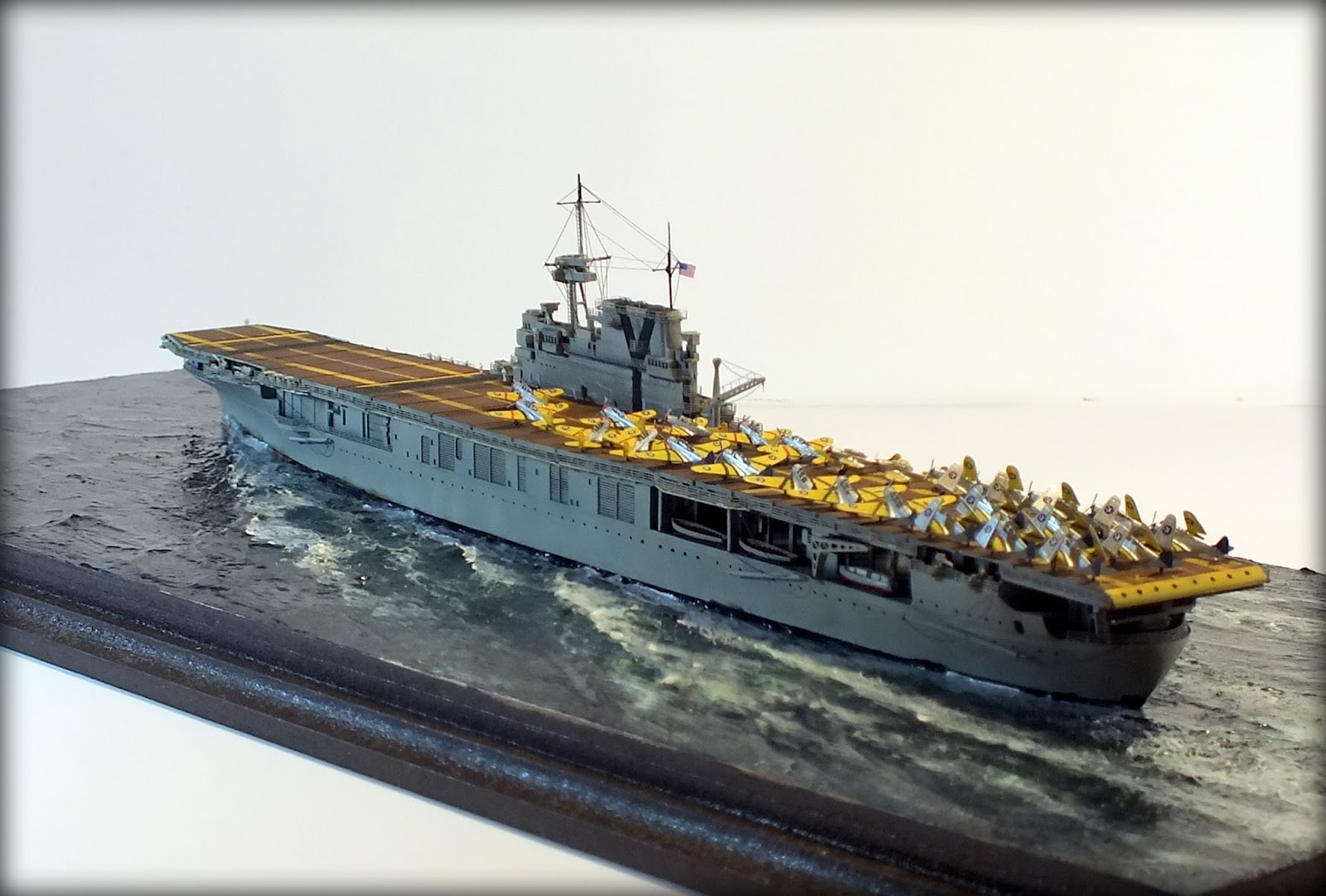
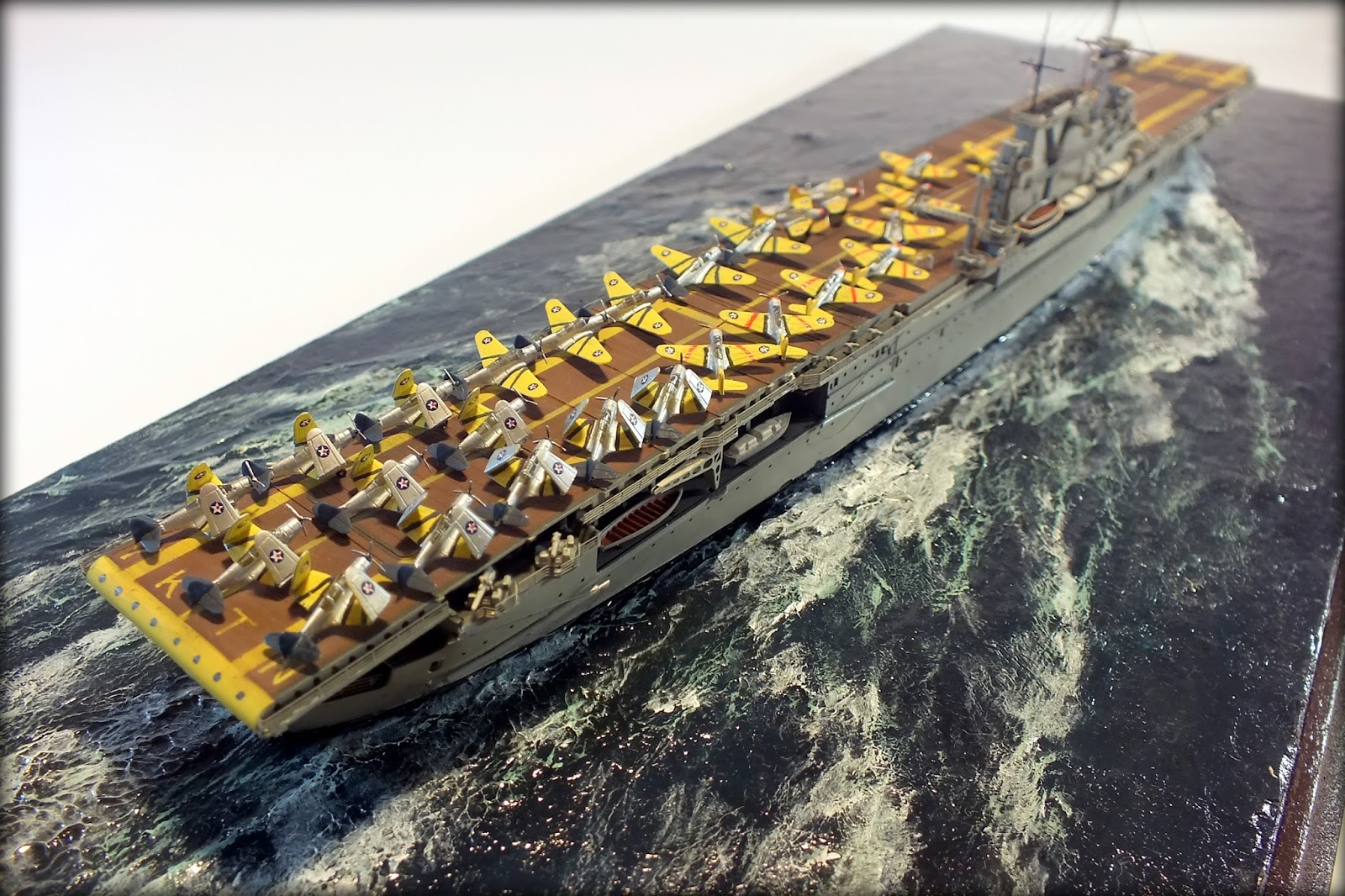
USS Yorktown (CV-5)


1/700 scale
Rebuilding a core set of Tamiya. The paper used book Okrety Wojenne SN-№23 "Lotnikowce typu Yorktown vol.1"
Changes to the model variants of the ship in 1940. Completely redesigned gallery of anti aircraft machine guns, fencing. Added a few design elements. The ship is painted in a light gray color, which is used by the US Navy until 1941.
Aircraft models are presented Douglas TBD Devastator & Douglas SBD Dauntless
These sets of Trumpeter - and in the appropriate paint for the period of 1940. Figures sailors from the company North Star.

The model is sold with a showcase. Showcase of Plexiglas, with classic wooden frame.

Size windows with Stand - 50x20x17,5


Tuesday, September 8, 2009

A-4F Skyhawk


Hasegawa kit
1:48

The Douglas A-4 Skyhawk is a carrier-capable ground-attack aircraft designed for the United States Navy and U.S. Marine Corps. The delta winged, single turbojet-engined Skyhawk was designed and produced by Douglas Aircraft Company, and later McDonnell Douglas. It was originally designated the A4D under the US Navy's pre-1962 designation system.

Fifty years after the aircraft's first flight, and having played key roles in the Vietnam War, the Falklands War, and the Yom Kippur War, a few of the nearly 3,000 Skyhawks produced remain in service with several air arms around the world, including active duty on the aircraft carrier of the Brazilian Navy.

A-4F: Refinement of A-4E with extra avionics housed in a hump on the fuselage spine (this feature later retrofitted to A-4Es and some A-4Cs) and more powerful J52-P-8A engine with 9,300 lbf (41 kN) thrust, later upgraded in service to J52-P-408 with 11,200 lbf (50 kN), 147 built. Some served with Blue Angels acrobatic team from 1973 to 1986.

Text: Wikipedia http://en.wikipedia.org/wiki/A-4_Skyhawk

Curtiss P-40K «Warhawk»


1:48
AMT/ERTL

Прекрасная модель. Полистирол мягок, податлив, декали в меру тонкий, расшивка выше всяких похвал. В наборе даны 2 версии хвостового оперения и 2 версии декалей — но какие!
Машина, данная в модели, принадлежала майору Эду Холмайеру из 16-й эскадрильи, что базировалась в Канмнинге, Китай. Так вот, вариант, приходящийся на середину февраля 1943 г., требует из декали обозначения побед (5 яп. флажков) отрезать 3 флажка. 2 вариант — середина лета 1943 г. — все 5 побед. Вот и всё. Просто и понятно. Но! Мой восторг вызывает ПРОФЕССИОНАЛЬНЫЙ подход авторов кита и фирмы к делу: чёткое соблюдение исторической последовательности. Согласитесь, не часто в моделях есть столь точные данные о предмете работы. Хотелось бы добавить немного о загаженности машины. Из множества фотографий, отображающих авиацию во время боевых действий в Индокитае, будь то 2-я Мировая или Вьетнам, хорошо заметно состояние авиатехники после даже небольшого периода службы. Посмотрите на обтёртые «Фантомы» и «Скайредеры» — и представьте себе 1943 год. Сомневаюсь, что в этом году, мат. тех. база была лучше укомплектована чем во время Вьетнама. Ну, а данные о сроке службы хотя бы прилагаемой машины позволяют дать почву для некоторой игры фантазии. Полгода в джунглях! Так что, вам судить.

P. S. Окрашивал любимым HUMBROL — кистью. Копоть, пыль и грязь — пастель.


Wright Flyer


Museum quality model in 1:3 scale for the Museum of Technologies, Haifa.
Model by Alexander & Inna Blokhin

The Wright Flyer (often retrospectively referred to as Flyer I and occasionally Kitty Hawk) was the first powered aircraft designed and built by the Wright brothers. The flight is recognized by the Fédération Aéronautique Internationale, the standard setting and record-keeping body for aeronautics and astronautics, as "the first sustained and controlled heavier-than-air powered flight"
Text: Wikipedia


Supermarine Spitfire Mk.VB


1:48
Hasegawa

This was the first production version of the Spitfire to use "clipped" wingtips as an option, reducing the wingspan to 32 ft 2 in (9.8 m). The clipped wings increased the roll rate at lower altitudes.


Supermarine Spitfire Mk.XIV


Academy
1:72

The first Griffon powered Spitfires suffered from poor high altitude performance due to having only a single stage supercharged engine. By 1943 Rolls-Royce engineers had developed a new Griffon engine, the 61 series, with a two-stage supercharger. In the end it was a slightly modified engine, the 65 series, which was used in the Mk XIV. The resulting aircraft was as great an improvement over the Mk IX as the Mk IX had been over the Mk V. Although initially based on the Mk VIII airframe, common improvements made in aircraft produced later included the cut-back fuselage and tear-drop canopies, and the E-Type wing with improved armament.
It could climb to 20,000 ft (6,100 m) in less than seven minutes and its top speed, which was achieved at 26,000 ft (7,900 m), was 448 mph (721 km/h)
The first test of the aircraft was in intercepting V1 flying bombs, and the Mk XIV was the most successful of all Spitfire marks in this role. The Spitfire XIV was also famous for being able to catch the notorious German jet, the Messerschmitt 262.The Mk XIV was used by the 2nd Tactical Air Force as their main high-altitude air superiority fighter in northern Europe.

Monday, June 29, 2009

Mig-15 Fagot


Dragon
1:72
Is there any aircraft modeler who doesn’t know about the Mig-15? Basing their design on captured German material, the Russian MiG Bureau’s famous Mig-15 first flew on the power of a British Neme jet engine, a number of which were exported to the USSR in 1947. Production aircraft first met USAF F-86 Sabres in the skies over Korea as the first true jet fighter combatants. Enormous numbers of Mig-15s (and the improved Mig-15bis) were built, the type serving in dozens of different airforces.

F-86F-30 Sabre


1:72
Fujimi
Version -- “THE HUFF” of the 39th FIS flown by Lieutenant Jim Thompson. Korean War, 1952.
The North American F-86 Sabre (sometimes called the Sabrejet) was an American transonic jet combat aircraft. The F-86 was developed in the late 1940s and was one of the most-produced Western jet fighters of the Cold War era. A variant of the F-86 was produced in large numbers in Canada, as the Canadair Sabre; the main variants were considerably modified with more powerful Avro Canada Orenda engines. The Canadair Sabre was acquired by several NATO and other air forces. U.S. variants were also built in Italy and Japan. A significantly-redesigned variant was built by CAC in Australia as the CAC CA-27, also known as the Avon Sabre.

The F-86 entered service with the United States Air Force in 1949, joining the 1st Fighter Wing's 94th Fighter Squadron "Hat-in-the-Ring" and became the primary air-to-air jet fighter used in the Korean War. With the introduction of the Soviet Mikoyan-Gurevich MiG-15 into air combat in November 1950, which out-performed all aircraft then assigned to the United Nations, three squadrons of F-86s were rushed to the Far East in December. The F-86 could out-turn and out-dive the MiG-15, but the MiG-15 was superior to the F-86 in ceiling, acceleration, rate of climb, and zoom (especially until the introduction of the F-86F in 1953); MiGs flown from bases in Manchuria by Chinese, Korean, and Soviet VVS pilots, were pitted against two squadrons of the 4th Fighter-Interceptor Wing forward-based at K-14, Kimpo, Korea.

Many of the American pilots were experienced World War II veterans while the North Koreans and the Chinese lacked combat experience, thus accounting for much of the F-86's success. However, whatever the actual results may be, it is clear that the F-86 pilots did not have as much success over the better trained Soviet piloted MiG-15s. Although Soviets piloted the majority of MiG-15s that fought in Korea, North Korean and Chinese pilots increased their activity as the war went on. The Soviets and their allies periodically contested air superiority in MiG Alley, an area near the mouth of the Yalu River (the boundary between Korea and China) over which the most intense air-to-air combat took place. The F-86E's all-moving tailplane has been credited with giving the Sabre an important advantage over the MiG-15. Far greater emphasis has been given to the training, aggressiveness and experience of the F-86 pilots. Despite rules-of-engagement to the contrary, F-86 units frequently initiated combat over MiG bases in the Manchurian "sanctuary."

51st FIG "Checkertails" at K-13 air base (Suwon, South Korea) are prepped for a mission

The needs of combat operation balanced against the need to maintain an adequate force structure in Western Europe led to the conversion of the 51st Fighter-Interceptor Wing from the F-80 to the F-86 in December 1951. Two fighter-bomber wings, the 8th and 18th, converted to the F-86F in the spring of 1953. No. 2 Squadron, South African Air Force also distinguished itself flying F-86s in Korea as part of the 18 FBW.

By the end of hostilities, F-86 pilots were credited to have shot down 792 MiGs for a loss of only 78 Sabres, a victory ratio of 10 to 1. Postwar totals officially credited by the USAF are 379 kills for 103 Sabres lost, amounting to a ratio of nearly 4 to 1. Modern research by Dorr, Lake and Thompson has claimed the actual ratio is closer to 2 to 1.

The Soviet claims of downing over 600 Sabres together with the Chinese claims are considered exaggerated by the USAF. Recent USAF records show that 224 F-86s were lost to all causes, including non-combat losses. But direct comparison of Sabre and MiG losses seem irrelevant, since primary targets for MiGs were heavy B-29 bombers and ground-attack aircraft, while the primary targets for Sabres were MiG-15s.

Of the 40 USAF pilots to earn the designation of ace during the Korean war, all but one flew the F-86 Sabre.


Text: Wikipedia